
DNA Testing Ancestry: Discover Your Family Roots Today
DNA testing uses a simple saliva sample to dig into your unique genetic code, offering a fascinating peek into your family’s past. This process can pinpoint your ethnic origins, connect you with living relatives you never knew you had, and even trace the migration paths your ancestors took thousands of years ago. It’s like opening a history book written just for you, in your very own DNA.
Disclaimer: The information provided in this blog is for informational purposes only and should not be constituted as medical or legal advice. It is not a substitute for professional medical guidance, diagnosis, or treatment. For any medical advice or in a medical emergency, please contact medically qualified doctors and hospitals operating under the jurisdiction of the place you reside.
Embarking on Your Genetic Journey
Welcome to the incredible world of genetic genealogy. This is where cutting-edge science and deep history come together to tell the unique story of your family. With just a simple DNA test, you can unlock centuries of your family’s history, connecting you to people and places that are all part of your heritage.
This guide is your roadmap. We’re here to demystify the science behind it all, walk you through the different types of tests available, and show you how to read your results with confidence. Think of this as your personal compass for exploring the rich, complex tapestry of your family’s past.
What Can You Discover?
When you start this journey, you open up a world of discovery. You might finally be able to verify those old family legends that have been passed down for generations, or you could stumble upon entirely new branches of your family tree you never knew existed. It’s a deeply rewarding experience that fosters a real connection to your roots.
But it’s about so much more than just seeing percentages on a map; it’s about understanding the human stories behind the data. Some of the key discoveries you can expect include:
- Ethnic Composition: A detailed breakdown of your ancestral origins, showing you the different regions around the globe your family came from.
- Living Relatives: You’ll get connected with cousins who share segments of your DNA. Many people find relatives they never knew they had.
- Ancient Migration Paths: Get a glimpse into the epic journeys your paternal or maternal lines took thousands of years ago as they moved across the world.
- Confirmation of Family Research: Genetic evidence can be the missing piece that either supports or challenges the findings from your traditional, paper-trail genealogy research.
This exploration into your genetic blueprint offers profound personal insights. It links you to the much larger story of human history and migration, providing a tangible connection to the past that makes history feel immediate and personal.
Ultimately, DNA testing gives you a brand-new lens for looking at your identity and heritage. It answers questions you’ve always had and often sparks new ones that can lead to a lifelong passion for genealogy.
To learn more about the DNA tests Suspire offers, please visit the Suspire Website. For further inquiries, you can contact us on WhatsApp to know more.
How DNA Reveals Your Family Story

Think of your DNA as a massive, ancient library, packed with books written by every single one of your ancestors. A DNA testing ancestry kit is simply the key that unlocks the door, letting you finally read those stories for yourself.
The science behind it is actually pretty straightforward. Labs analyze your unique genetic code, searching for specific markers that act like little signposts pointing to your past. They then compare these markers against a huge database of DNA from people all over the world who have well-documented family trees tied to specific places.
It’s like having one unique piece of a giant global puzzle. By seeing where your piece fits among all the others, a picture of your own history starts to take shape, revealing connections that can stretch across continents and back through the centuries.
The Three Main Books in Your Genetic Library
To really get a handle on your results, you need to know about the three main types of DNA that these tests look at. Each one is like a different kind of book in your genetic library, telling a unique part of your family’s history. When read together, they weave a rich, detailed narrative of where you come from.
The three key types are:
- Autosomal DNA (atDNA): This is the big encyclopedia, covering your entire family tree for the most recent generations.
- Y-Chromosome DNA (Y-DNA): This is a specialized history, passed down strictly from father to son.
- Mitochondrial DNA (mtDNA): This book tells the story passed from a mother to all her children.
Each test offers different clues, and knowing what they do is the first step to piecing together your genetic story. Let’s take a closer look at what each of these “books” can tell you.
Autosomal DNA: Your Complete Family Story
Autosomal DNA, or atDNA, makes up the bulk of your genetic library. You inherit it from both of your parents, who got it from their parents, and so on. This means your atDNA is a blend of contributions from all branches of your family tree—your mom’s side, your dad’s side, and everyone in between.
Because it’s such a broad mix of your recent ancestors, atDNA testing is incredibly powerful for two main things. First, it’s what gives you those ethnicity percentages that pinpoint where your ancestors lived over the last several hundred years. Second, it’s the number one tool for finding living relatives on every side of your family, from first cousins to distant relations you never knew you had.
Y-DNA: Tracing the Paternal Line
The Y-chromosome has a unique job: it’s passed directly from a father to his son, staying almost identical from one generation to the next. This makes Y-DNA testing an amazing tool for tracing a direct paternal line—your father’s father’s father, and his father before him—back for thousands of years.
Since family names often follow this same paternal path, Y-DNA is a game-changer for surname projects, where people with the same last name team up to track down common ancestors. The catch? Only males have a Y-chromosome, so only they can take this test. If a woman wants to explore her paternal line, she’ll need to ask a male relative like her father, brother, or paternal uncle to test for her.
Your DNA doesn’t just connect you to recent family; it links you to the grand saga of human migration. Y-DNA and mtDNA tests can reveal your deep ancestral ‘haplogroup,’ which is like a clan marker that traces your lineage back to ancient origins and follows their journey across the globe.
mtDNA: Following the Maternal Line
Mitochondrial DNA, or mtDNA, tells the story of your direct maternal lineage. It’s passed down from a mother to all of her children, but here’s the twist: only her daughters will pass it on to the next generation. This creates an unbroken chain connecting you to your mother, her mother, her mother’s mother, and on and on, deep into the ancient past.
Because mtDNA changes so slowly, it isn’t the best tool for finding recent relatives. It shines, however, as the ultimate way to trace your deep maternal ancestry. It can connect you to ancient matriarchal clans that lived tens of thousands of years ago. Both men and women inherit mtDNA from their mothers, so anyone can take this test to explore their direct maternal line.
Choosing the Right DNA Test for Your Goals
So, you’re ready to dive into your family’s past with a DNA test. That’s fantastic! But before you jump in, it’s important to know that not all tests are created equal. The right one for you really depends on what you’re hoping to find out. Think of it like choosing the right tool for a job—you wouldn’t use a hammer to saw a piece of wood.
Are you trying to connect with living relatives and get a broad overview of where your recent ancestors came from? Or are you on a mission to trace your father’s direct line back through the ages? Answering that question is the first step to picking the test that will give you the answers you’re looking for.
Autosomal DNA for a Broad Family View
If you’re just starting out, an Autosomal DNA (atDNA) test is almost always the best place to begin. It’s the most popular for a reason: it casts the widest possible net, giving you a detailed picture of your genetic heritage from all sides of your family over the last five to seven generations.
You inherit autosomal DNA in mixed-up chunks from both of your parents, which means it contains genetic clues from every branch of your family tree. This makes it perfect for two things: getting that fascinating ethnicity estimate with percentages from around the world, and finding living relatives you never knew you had, from both your mom’s and dad’s sides.
- Who Can Take It? Absolutely anyone, male or female.
- What It Reveals: A breakdown of your ethnic origins by percentage and a list of DNA matches (cousins!) from every part of your family.
- Best For: Finding living relatives, building out your recent family tree, and getting a comprehensive look at your global ancestry.
Because it examines your entire genetic story, the atDNA test is the go-to for most people. If you’re curious about the different options available, you can browse a variety of home DNA testing kits to see which one fits your goals.
This image breaks down the three core pieces of information you’ll get from a typical ancestry DNA report.
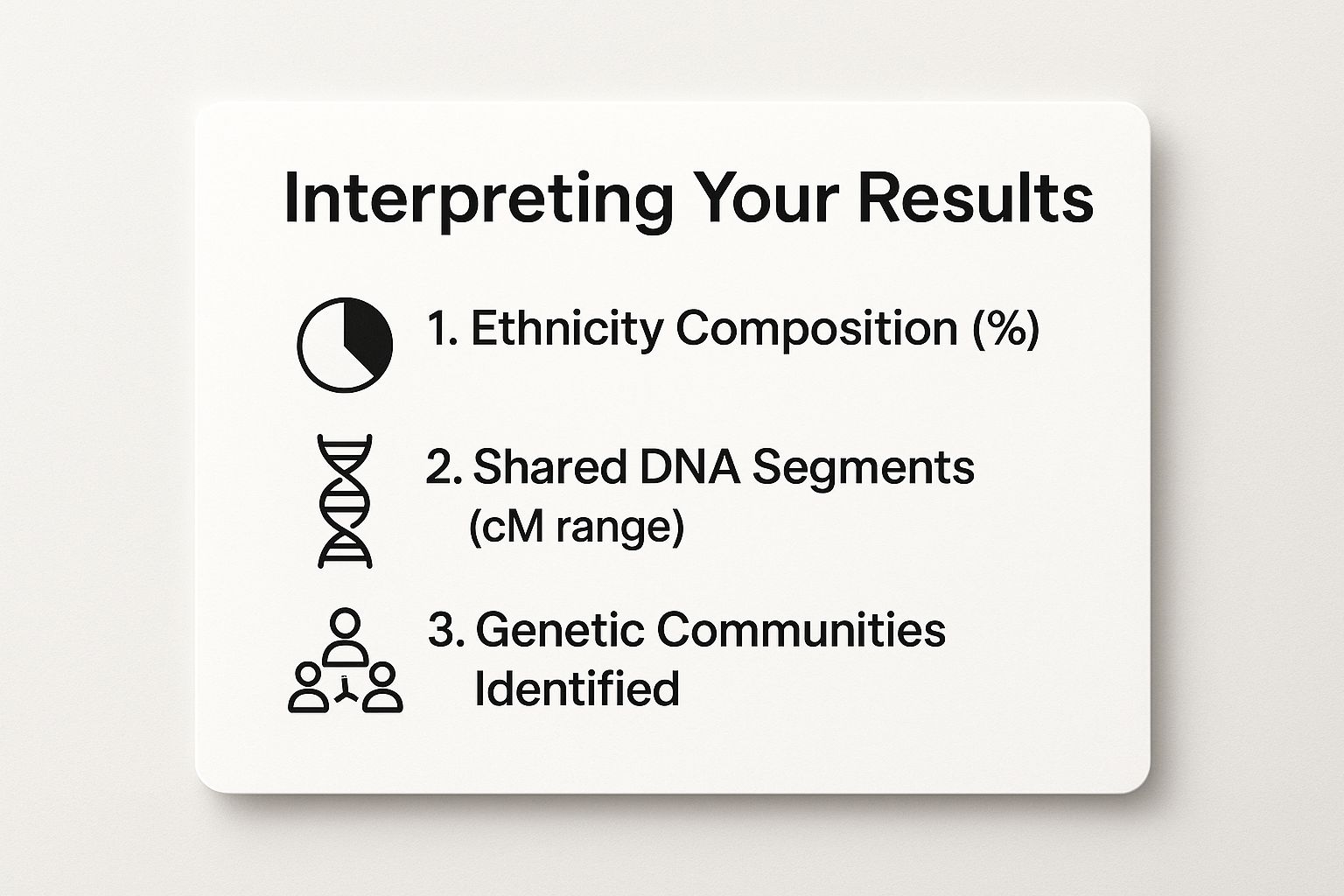
As you can see, the combination of your ethnicity estimate, your DNA matches, and your genetic communities gives you a rich, multi-layered view of where you come from.
To help you decide which test is the best fit, here’s a quick side-by-side comparison.
A Comparison of DNA Ancestry Tests
Use this table to quickly see how the three main DNA tests stack up against each other. It’s a simple way to match your research goals with the right scientific tool.
| Feature | Autosomal DNA (atDNA) | Y-Chromosome DNA (Y-DNA) | Mitochondrial DNA (mtDNA) |
|---|---|---|---|
| Inheritance | From both parents, all ancestral lines | From father to son only | From mother to all children |
| Who Can Test? | Anyone (males and females) | Biological males only | Anyone (males and females) |
| Primary Use | Finding recent relatives (last 5-7 generations), ethnicity estimates | Tracing a direct paternal line (surname studies) | Tracing a direct maternal line (ancient ancestry) |
| Genealogy Goal | Building a wide, recent family tree | Breaking through paternal “brick walls” | Exploring deep maternal origins |
| Relative Matching | Finds cousins on all family branches | Finds matches on the direct paternal line only | Finds distant matches on the direct maternal line |
| Haplogroup | No | Provides a paternal haplogroup | Provides a maternal haplogroup |
Each test offers a unique window into your past. Your choice simply depends on which part of your family story you want to explore first.
Y-DNA for a Direct Paternal Line
If atDNA is a wide-angle photo of your family, think of a Y-DNA test as a high-powered telescope aimed at a single, unbroken line: your father’s, his father’s, his father’s father, and so on.
The Y-chromosome is passed down from father to son almost unchanged through the generations. This makes it an incredibly precise tool for tracing a direct paternal lineage back thousands of years. It’s a game-changer for surname projects, where men with the same last name can confirm whether they share a common ancestor.
A Y-DNA test can be the key to smashing through those frustrating “brick walls” in your research, especially when paper records are missing or surnames were changed. It provides a genetic signature for your paternal line that documents alone might never uncover.
- Who Can Take It? Only biological males, because only they have a Y-chromosome. If you’re a female researcher, you’ll need to test a male relative on that line, like your father, brother, or a paternal uncle.
- What It Reveals: Your deep paternal haplogroup and matches to other men who share your direct paternal ancestor.
- Best For: Surname research, confirming a paternal family connection, and tracing ancient male migration routes.
mtDNA for a Direct Maternal Line
Just like Y-DNA, Mitochondrial DNA (mtDNA) follows one direct line deep into the past—but this time, it’s your mother’s. mtDNA is passed from a mother to all of her children, but only her daughters will pass it on to the next generation.
This creates a direct genetic link from you to your mother, her mother, her mother’s mother, and so on, for thousands of years. Because mtDNA mutates very slowly, it isn’t great for finding close cousins. Its real power is in tracing your ancient maternal roots and revealing your maternal haplogroup, which connects you to an ancient clan of women.
- Who Can Take It? Anyone! Both men and women inherit mtDNA from their mothers.
- What It Reveals: Your deep maternal haplogroup, linking you to ancient female clans and their journeys across the globe.
- Best For: Exploring your direct maternal line into deep history and confirming if two people share a common maternal ancestor.
Making Sense of Your Ethnicity Estimate
There’s a real thrill that comes with opening your DNA ancestry results and seeing that ethnicity breakdown for the first time. It’s usually a colorful map with percentages that give you a powerful, visual link to the places your ancestors likely called home. But how do these companies actually figure this out from a simple saliva sample?
The whole process is a fantastic mix of hard genetics and sophisticated data science. Essentially, your unique DNA is compared against massive databases filled with DNA samples from all over the world. These collections, known as reference populations, are made up of individuals with deep, well-documented family trees from very specific geographic locations.
You can think of it like this: every reference population has its own distinct genetic “accent.” The testing lab analyzes your DNA, listens for these different accents, and figures out the percentage of each one in your genetic makeup. That’s how you get a result like “40% Scandinavian” or “15% Italian.”
Why Is It an “Estimate”?
You’ll always see the term “ethnicity estimate,” never “ethnicity fact.” That wording is very intentional and really important to understand. While the results are based on rigorous science and huge datasets, they represent the most accurate interpretation possible with today’s technology and data.
The precision of your estimate is directly tied to the size and diversity of the reference populations the company uses. The more comprehensive and varied these DNA databases are, the better they can pinpoint your origins. And since science never stands still, these databases are constantly being updated and refined.
As more people from different parts of the world take DNA tests, our collective genetic map becomes sharper and more detailed. This means your own ethnicity estimate might actually change and evolve over time, getting more specific with each major update to the reference database.
This continuous improvement is one of the most exciting parts of the journey. A region that might have been labeled broadly as “West Asia” five years ago could now be broken down into more specific communities, giving you a much clearer picture of your heritage.
The Power of Diverse Genetic Data
For a long time, the world’s major DNA databases had a strong European bias. This made it tough to deliver highly detailed and accurate results for people whose roots were in other parts of the world, like Africa, Asia, or the Middle East. Thankfully, dedicated research projects are working hard to change that.
Initiatives that focus on mapping the genetics of underrepresented populations are absolutely vital for improving accuracy for everyone. A perfect example of this is the Moroccan Genome Project (MGP), a groundbreaking effort to sequence Moroccan genomes and map the unique genetic diversity of North Africa.
The MGP was a game-changer. It uncovered over 27 million genetic variants that were unique to the North African population and helped create a specific reference genome that drastically improves results for people with Moroccan ancestry. Projects like this are filling in critical gaps in our knowledge, ensuring that people from all backgrounds receive a richer, more accurate picture of their family story.
Ultimately, your ethnicity estimate is a dynamic, living snapshot of your deep history. It’s not an endpoint, but a fantastic starting point for discovery, connecting you to the global human story in a way that’s uniquely personal.
To discover more about the DNA tests Suspire offers, please visit the Suspire Website. You can also contact us on WhatsApp to know more.
Tracing Ancient Ancestry with Haplogroups
While your ethnicity estimate paints a vibrant picture of your recent family history, Y-DNA and mtDNA tests offer something else entirely. Think of them as a genetic time machine, hurtling you thousands of years into the past to uncover your haplogroup.
What exactly is a haplogroup? It’s your ancient genetic clan. It represents a major branch on the colossal human family tree, defined by a specific genetic marker that everyone descended from a common, long-ago ancestor shares. Finding out your haplogroup is like discovering which ancient tribe you belong to, plugging your personal story directly into the epic saga of human migration.
Each haplogroup tells a unique story, tracing a specific path our ancestors took after migrating out of Africa tens of thousands of years ago. Your result might look something like “R1b” for your paternal line or “H1” for your maternal line. Each letter and number is a distinct chapter in the story of humanity.
What Your Haplogroup Reveals
Let’s be clear: your haplogroup won’t tell you about your second cousin. It’s far bigger than that. It tells you about your 2,000th-great-grandparent. It pinpoints the geographic origins of your deep paternal or maternal lineage and follows their movements across continents over millennia.
For instance, one Y-DNA haplogroup might be closely linked to the early Celtic people of Western Europe. A particular mtDNA haplogroup, on the other hand, could trace your maternal line all the way back to the first hunter-gatherers who settled in Southeast Asia. This kind of information adds an incredible layer of depth to where you come from. Your dna testing ancestry journey transforms from a family affair into an ancient historical quest.
These deep ancestral markers are passed down almost unchanged through either the direct paternal line (Y-DNA) or the direct maternal line (mtDNA), making them incredibly stable signposts of our ancient heritage.
The Importance of Regional Genome Programs
How accurate are these ancient migration maps? Their detail and precision depend entirely on the quality and diversity of the genetic data scientists have to work with. For a long time, many global databases were heavily skewed, leaving huge gaps in our understanding of populations from around the world.
This is where focused research becomes absolutely critical. Population Genome Programs (PGPs) across the Middle East and North Africa (MENA) region—including the UAE, Saudi Arabia, and Qatar—are now collecting large-scale genome data. Their goal is to map the unique genetic variations of these populations. This work is vital for discovering new genetic markers and sharpening our understanding of ancient human history, especially for anyone with roots in these historically rich areas.
By building detailed genetic maps of specific populations, these programs help science connect the dots between ancient migrations and modern descendants. This research provides richer, more accurate insights for everyone, filling in crucial pieces of the human story that were previously missing.
At the end of the day, understanding your haplogroup is a profound experience. It connects you to a shared past with thousands of others who carry the same ancient marker, no matter where they live today. It’s a powerful reminder that your family’s story began long, long before recorded history.
To learn more about the DNA tests Suspire offers, you are invited to visit the Suspire Website. To know more, feel free to contact us on WhatsApp.
Using DNA to Build Your Family Tree
Your DNA test results are so much more than a static report—they’re a living, breathing tool for building out your family history. When you combine your genetic insights with old-fashioned genealogy research, you unlock a whole new world of discovery. Suddenly, you can confirm long-told family stories, connect with living relatives you never knew you had, and smash through those frustrating research barriers.
It all starts with your DNA match list. This is where you’ll find other people in the testing database who share significant chunks of your DNA. These are your genetic cousins, and every single match is a potential clue that can help you piece together your ancestral puzzle and grow your family tree.
Collaborating with Your DNA Matches
Reaching out to a new cousin might feel a bit awkward at first, but trust me, it’s one of the best ways to make real progress. A simple, clear message is all it takes. Just introduce yourself, mention how you think you’re related based on the shared DNA, and share a little about the family lines you’re focused on.
When you team up, you can pool your knowledge and resources. A cousin might have that one old family photo that finally puts a face to a name, or the missing birth certificate you’ve spent months searching for. Some of the most effective ways to collaborate include:
- Sharing Family Trees: Lay your documented family trees side-by-side. This is often the quickest way to spot the common ancestor you both descend from.
- Focusing on Shared Matches: Use the “in common with” tools to see which other DNA matches you share. This helps you build out genetic clusters that almost certainly trace back to the same ancestral couple.
- Combining DNA with Documents: Use your genetic link as a roadmap to focus your search in historical records like census data, marriage certificates, and land deeds.
Your list of DNA matches is a dynamic resource. By systematically working through these connections, you can verify relationships and uncover new branches of your family that paper trails alone might never have revealed.
This whole process turns your research from a solo mission into a collaborative adventure. You can get more details on how to get started by exploring our guide to family tree DNA tests.
Breaking Through Genealogical Brick Walls
Every genealogist hits one eventually—that frustrating “brick wall” where the paper trail just goes cold, leaving an ancestor’s story hanging. This is precisely where DNA testing becomes your secret weapon. By finding cousins who descend from different children of your brick-wall ancestor, you can use the DNA you all share to confirm the connection and hopefully uncover new leads in their family records.
The growing interest in genetics is making this easier than ever. This trend is visible in the Middle East, where the genetic testing market was valued at approximately USD 4.18 billion and is projected to grow to USD 7.46 billion by 2033, driven by initiatives like the UAE Genome Program. This explosion in testing means the pool of potential relatives you can connect with is constantly expanding, dramatically increasing your chances of solving even the most stubborn family mysteries.
To discover more about the DNA tests Suspire offers, please visit the Suspire Website. You can also contact us on WhatsApp to know more.
Have Questions About DNA Ancestry Testing? You’re Not Alone.
Jumping into the world of DNA testing for ancestry naturally brings up a lot of questions. From the science humming away behind the scenes to how your personal data is handled, it’s smart to be curious. We get these questions all the time, so let’s walk through some of the most common ones people have before they start their genetic journey.
Getting clear, straightforward answers is the best way to feel confident and make the most of this incredible experience.
Just How Accurate Are These Tests?
When it comes to identifying close family, the science is rock-solid. If a test flags someone as a first or second cousin, that genetic link is highly reliable. You simply share a large, measurable chunk of DNA that can’t be mistaken.
Your ethnicity estimate is another story, but still highly reliable. Think of it as the best scientific interpretation based on today’s data. It’s called an “estimate” for a reason—it can actually get sharper over time. As more people from every corner of the globe get tested, the reference databases expand, allowing for more and more precision in your results.
Is My Genetic Information Kept Private?
Absolutely. Any reputable testing company has strict security measures in place to protect your data. More importantly, you are always in the driver’s seat. You control your privacy settings, deciding who gets to see your results or whether your anonymized data can contribute to broader research projects.
It’s always a good idea to read the privacy policy of any company before you test. At Suspire, we encourage you to review our policies, as we take data security seriously, giving you complete control over how your information is managed.
Your DNA results are just the beginning of the story! They’re like a key that can unlock entirely new chapters of your family’s history, especially when you pair them with historical records and connect with newfound relatives.
Your journey doesn’t stop when you get your report; that’s where the real adventure kicks off. You can use your results to flesh out a detailed family tree, connect with cousins you never knew you had, and even join communities built around your specific ancestral roots.
Ready to uncover your own family story? Suspire offers a range of DNA tests to help you connect with your past. Explore our options by visiting the Suspire Website or get your questions answered directly by contacting us on WhatsApp.
