
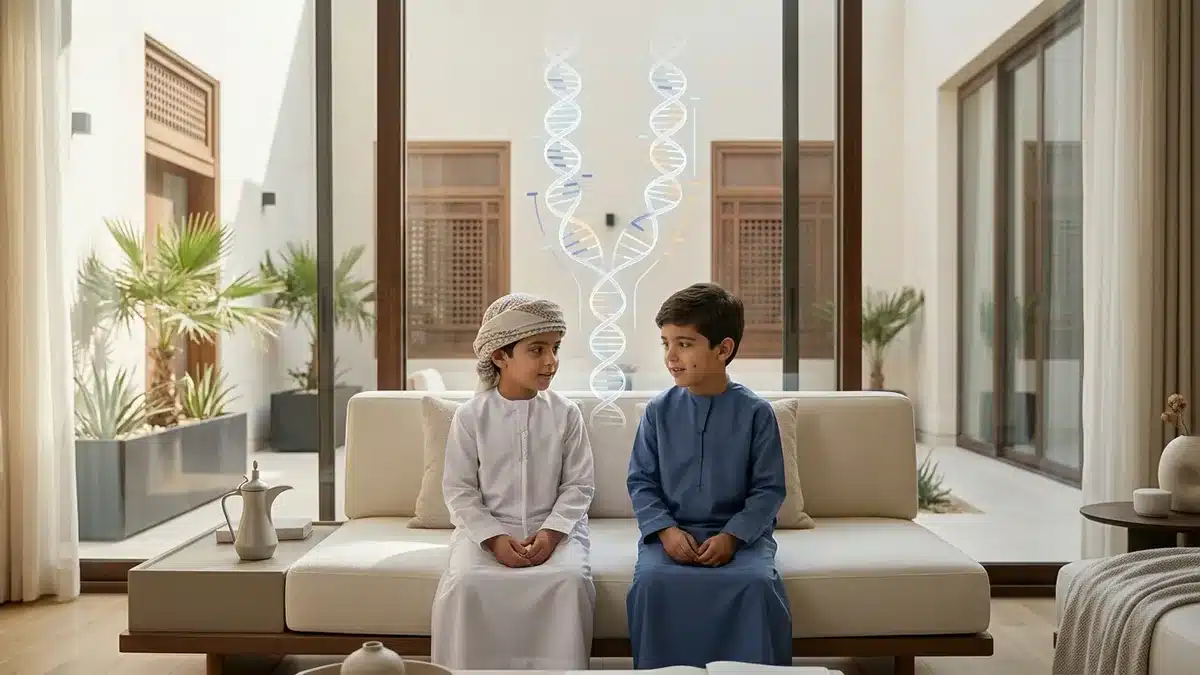
Identical or Fraternal Twins? How Can DNA Testing Tell?
An identical or fraternal twins DNA test compares genetic information from both twins to determine their zygosity — whether they developed from the same fertilized egg or from two separate fertilized eggs.
What Does “Zygosity” Mean?
When people ask whether twins are identical or fraternal, the scientific question being asked is about their zygosity.
Zygosity describes whether the twins originated from the same fertilized egg or from two independently fertilized eggs.
Identical Twins
Monozygotic twins develop when one fertilized egg forms a single zygote and subsequently separates into two embryos.
Because the twins originate from the same fertilization event, their inherited genetic profiles are expected to be extremely similar.
Fraternal Twins
Dizygotic twins develop from two separate eggs that are fertilized separately.
Genetically, they therefore resemble ordinary full siblings who happen to develop during the same pregnancy.
How Do Identical and Fraternal Twins Develop?
One egg is fertilized by one sperm, creating one zygote. During early development, that developing embryo separates and gives rise to two embryos.
Two eggs are released and each is fertilized independently. The resulting embryos develop during the same pregnancy but originate from separate fertilization events.
Why Might Parents Be Unsure Whether Twins Are Identical?
Some twin pairs look remarkably similar, while others become less similar as they grow. Appearance alone does not always provide a definitive answer about zygosity.
Families may also receive assumptions based on features observed during pregnancy or at birth. While pregnancy information can provide useful clues, DNA-based zygosity testing can directly examine the twins' genetic profiles when a clearer answer is needed.
How Does an Identical or Fraternal Twins DNA Test Work?
A twin zygosity test compares genetic information obtained from both twins.
The laboratory examines multiple genetic markers to determine whether the twins' profiles are consistent with monozygotic or dizygotic twinning.
What Does the DNA Comparison Show?
Consistent With Identical Twins
If the tested genetic markers show the expected level of concordance across the twins, the findings may support monozygotic twinning.
Consistent With Fraternal Twins
Differences across relevant genetic markers demonstrate that the twins do not share the same conventional genetic profile and are consistent with dizygotic twinning.
It is not simply measuring how similar the twins look. The laboratory compares genetic information from the twins themselves.
Do Identical Twins Really Have Exactly the Same DNA?
For routine twin zygosity determination, monozygotic twins are treated as having the same inherited genetic origin because they develop from the same zygote.
However, saying that identical twins are literally genetically identical in every cell throughout their lives would be an oversimplification.
Small genetic changes can arise after the original embryo divides, and biological differences can also develop through epigenetic and environmental processes.
These distinctions are important in genetics research, but they do not change the basic definition of monozygotic twinning.
How Much DNA Do Fraternal Twins Share?
Fraternal twins are biologically comparable to other full siblings in terms of their inherited genetic relationship.
They share the same biological parents but result from independent fertilization events. On average, full siblings share roughly half of their inherited genetic variation, although the exact amount varies between individual sibling pairs.
Being born during the same pregnancy does not make dizygotic twins genetically identical.
Can a Boy and Girl Be Identical Twins?
In ordinary twin biology, a male-female twin pair is generally considered dizygotic because the twins differ in sex chromosome composition.
Human biology does contain rare genetic exceptions and atypical developmental situations, so unusual clinical cases should be interpreted by an appropriately qualified medical professional rather than relying on a general educational rule.
If Twins Look Exactly Alike, Are They Definitely Identical?
No.
Physical resemblance can be a useful clue, but appearance is influenced by many traits. Fraternal twins can sometimes look remarkably similar, particularly when they share strong family characteristics.
Research comparing questionnaire or appearance-based zygosity classifications with DNA analysis has shown that appearance-based approaches can be highly useful, but DNA testing remains the more direct method when certainty is required.
Does Sharing a Placenta Prove Twins Are Identical?
Placental and membrane arrangements can provide information about how a twin pregnancy developed, but these observations should not automatically be treated as a substitute for DNA-based zygosity determination.
Medical interpretation of chorionicity and amnionicity belongs to obstetric care. When the specific question is genetic zygosity, DNA analysis examines the genetic relationship between the twins directly.
Can Identical Twins Have Different Personalities or Health Conditions?
Yes.
Sharing the same monozygotic origin does not mean two people will have identical lives, personalities, physical measurements or health outcomes.
Environmental exposures, development, lifestyle, random biological variation and epigenetic differences can contribute to differences between monozygotic twins.
What Can Twin Zygosity Testing Tell You?
Twin Biological Origin
The test can assess whether the twins' genetic profiles are consistent with monozygotic or dizygotic twinning.
In everyday language, this means determining whether they are genetically consistent with identical or fraternal twins.
Everything About the Twins
Zygosity testing does not predict personality, intelligence, future health, talents or how similar the twins will appear as they grow.
It answers a specific biological relationship question.
Common Misunderstandings About Identical and Fraternal Twins
Physical resemblance alone cannot always establish zygosity.
The determination is based on the twins' genetic profiles rather than appearance.
Dizygotic twins arise from separate fertilization events and have the same basic degree of biological sibling relationship as other full siblings.
Monozygotic twins can differ in appearance, health, behaviour and many other traits.
DNA-Based Zygosity Determination
Genetic analysis is widely used in twin research to determine whether twin pairs are monozygotic or dizygotic. DNA-based testing is considered the reference approach when zygosity needs to be established directly.
Read the PubMed research on determining zygosity in infant twins →Related Educational Guides
Frequently Asked Questions About Twin DNA Testing
What is a twin zygosity DNA test?
It is a genetic comparison used to determine whether a twin pair is monozygotic, commonly called identical, or dizygotic, commonly called fraternal.
What is the difference between identical and fraternal twins?
Identical twins originate from one fertilized egg that divides into two embryos. Fraternal twins originate from two separately fertilized eggs.
Can cheek swabs be used to determine twin zygosity?
DNA suitable for genetic comparison can commonly be obtained from cheek-swab samples, subject to the laboratory's collection and testing requirements.
Can twins look identical but actually be fraternal?
Yes. Physical resemblance alone does not conclusively establish zygosity. Genetic comparison can provide a direct assessment.
Are fraternal twins genetically the same as ordinary siblings?
In terms of their basic degree of genetic relationship, dizygotic twins are comparable to other full siblings because they arise from independent fertilization events involving the same biological parents.
Are identical twins genetically identical in every possible way?
Monozygotic twins originate from the same zygote and therefore begin with essentially the same inherited genome. Small genetic, epigenetic and developmental differences can arise over time.
Does the placenta determine whether twins are identical?
Pregnancy observations can provide information about twin development, but placental arrangement should not automatically be treated as equivalent to DNA-based zygosity determination.
The Question DNA Testing Can Answer
When a family wonders whether twins are identical or fraternal, the scientific question is whether the twins are monozygotic or dizygotic.
Rather than relying solely on appearance, family assumptions or how similar the twins behave, DNA testing compares their genetic profiles directly.
The result therefore addresses a specific question about the biological origin of the twin pair.
