
Ancestry DNA Testing in the UAE & GCC: Understand Your Origins and Family Lines
A DNA ancestry test can open new paths into your family history—but only when you choose the right type of evidence. Learn how genetic relatives, population estimates, paternal Y-DNA and maternal mtDNA answer different questions, and how to build a meaningful research plan using FamilyTreeDNA tests available through Suspire.
Two distinct roles, one simpler customer journey: Suspire helps you select an appropriate FamilyTreeDNA ancestry test, understand collection instructions, and coordinate DNA kit delivery, sample pickup and onward shipment to the FamilyTreeDNA laboratory in the United States. FamilyTreeDNA performs the laboratory genetic analysis and provides ancestry results through its platform. Suspire is a service facilitator—not the DNA testing laboratory or the issuer of genetic reports.
Quick answer: What is the best DNA test for ancestry? For most beginners, Family Finder is a practical starting point because it explores ancestry across many branches of your family tree and can identify potential DNA relatives. If you want to investigate your direct father-to-son line, choose Y-DNA. For your direct mother-to-child line, choose Full mtDNA Sequence. Combined packages help study more than one dimension of ancestry.

What Is an Ancestry DNA Test—and What Can It Actually Reveal?
An ancestry DNA test examines selected inherited genetic markers to investigate biological family connections and historical genetic ancestry. Depending on the test, results may provide estimated ancestral population connections, a list of possible genetic relatives, or information about one direct paternal or maternal lineage.
Ancestry testing is not the same as identifying someone's nationality, surname, religion or tribe. A country is a political category; a family tree is a genealogical record; a genetic population is identified through patterns in DNA data. These often relate to one another, but they are not interchangeable. This distinction matters particularly for families whose ancestors moved through Arabia, the Gulf, South Asia, East Africa, Iran and neighbouring regions over many generations.
The most informative interpretation usually combines three sources: the genetic test, genealogical records and family knowledge. DNA may point you towards a useful branch of research; documents and relatives can help establish the actual family connection.
Who shares your DNA?
Autosomal matching estimates possible relationships with other people in a participating database. Finding a match depends on who else has tested and opted into matching.
Which populations are genetically similar?
Ethnicity or population estimates compare parts of your DNA with reference groups. Percentages are estimates, not permanent statements of identity.
Where does one branch lead?
Y-DNA and mtDNA can trace particular unbroken parental lines far deeper in time, though those lines represent only a small fraction of all ancestors.
Family Finder vs Y-DNA vs mtDNA: Understanding the Difference
The word ancestry can describe several separate research goals. This comparison is the most important step when selecting a test.
| Test | DNA inheritance | Best research question | Who can provide a sample? |
|---|---|---|---|
| Family Finder | Autosomal DNA from both parents | What are my broader origins and which potential relatives share my DNA? | Men and women |
| Y-DNA 37 / 111 | Y chromosome on one direct paternal line | What can I learn from my father-to-son lineage and its DNA matches? | A person with an appropriate Y chromosome, usually a genetic male |
| Big Y-700 | Advanced Y-STR and Y-SNP analysis | Which deeper paternal genetic branch or sub-branch can I investigate? | A person with an appropriate Y chromosome, usually a genetic male |
| Full mtDNA Sequence | Mitochondrial DNA passed from mother to children | What is my direct mother-to-mother lineage and maternal haplogroup? | Men and women |
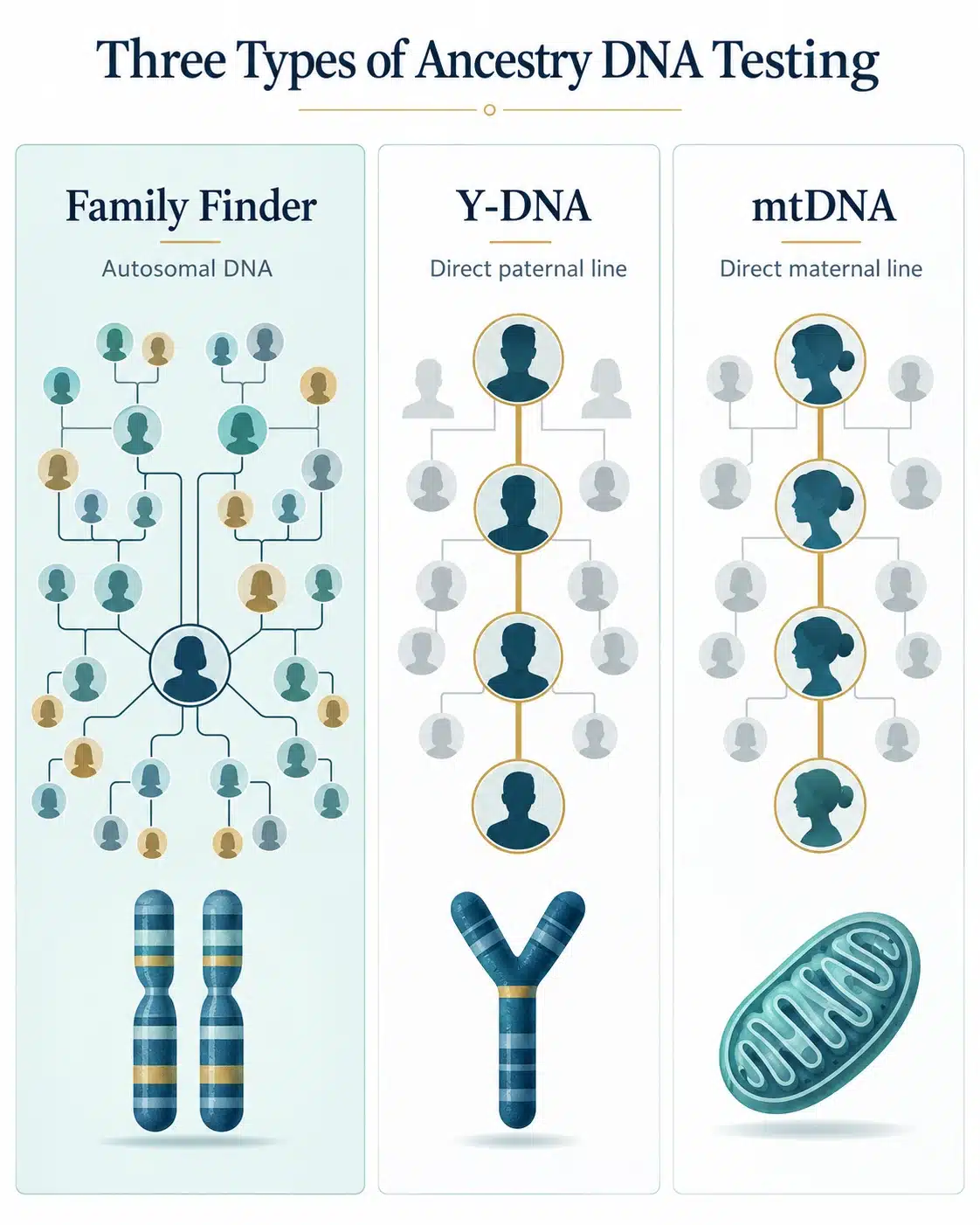
Imagine a family tree containing hundreds of ancestors. Family Finder draws information from many ancestral branches. Y-DNA examines just the direct paternal chain—your father, his father, his father and so on. mtDNA examines only the direct maternal chain—your mother, her mother, her mother and so on. These approaches complement each other; they are not simply cheap, medium and premium versions of the same test.
Family Finder: The Best Starting Point for Broad Ancestry and DNA Relatives
Family Finder from FamilyTreeDNA is an autosomal DNA test designed to examine genetic connections from both sides of your family tree. It is often suitable for someone ordering their first ancestry test, an adopted adult researching biological relatives, or a family historian looking for cousin matches to extend a family tree.
What results can Family Finder provide?
- Estimated genetic origins: FamilyTreeDNA's myOrigins compares your DNA with reference populations to provide regional or population-percentage estimates.
- Potential DNA relatives: Genetic matches can include close or more distant relatives who are in the testing database and participate in matching.
- Shared DNA segments: Matching tools can help researchers interpret DNA shared with possible relatives. Strong conclusions still require appropriate corroboration.
- Family-history starting points: Researching a match's family tree, ancestral surnames or locations can help turn an unexplained match into a documented family connection.
How many generations can an autosomal DNA test trace?
In brief: Autosomal tests are generally most useful for discovering genealogical relatives within approximately the last five generations, although more distant matches are possible and individual results vary. Ethnicity estimates may describe older population connections, but they do not reconstruct an exact list of all historical ancestors.
FamilyTreeDNA notes that it is designed for matches across roughly five generations and that interpreting shared ancestry becomes more difficult farther back because DNA inheritance is random. A genealogical ancestor can be genuine even when you have no detectable matching autosomal segment from that person today.
When Family Finder may be insufficient
Family Finder does not automatically tell you the precise family branch behind every cousin match, nor does an ethnicity estimate identify one ancient tribe or a specific grandfather. If your main objective is to investigate the direct paternal surname line or your maternal haplogroup, a complementary lineage test may be more useful than additional interpretation of an ethnicity percentage.
Y-DNA Testing: Trace a Direct Paternal Line, Surname Branch or Haplogroup
Y-DNA examines markers on the Y chromosome, passed through the direct father-to-son line. Because much of this chromosome is inherited along one paternal line, it can be particularly valuable in genetic-genealogy projects that compare men descended through the same paternal branch.
Who should provide the DNA sample? Someone who has the relevant Y chromosome for the paternal line being investigated. A woman who wishes to research her father's direct paternal line may ask her father, a paternal brother who shares the same father, paternal uncle, or another appropriately related male-line relative to test—with that person's informed consent. Not every male relative carries the Y chromosome of the exact line you wish to study.
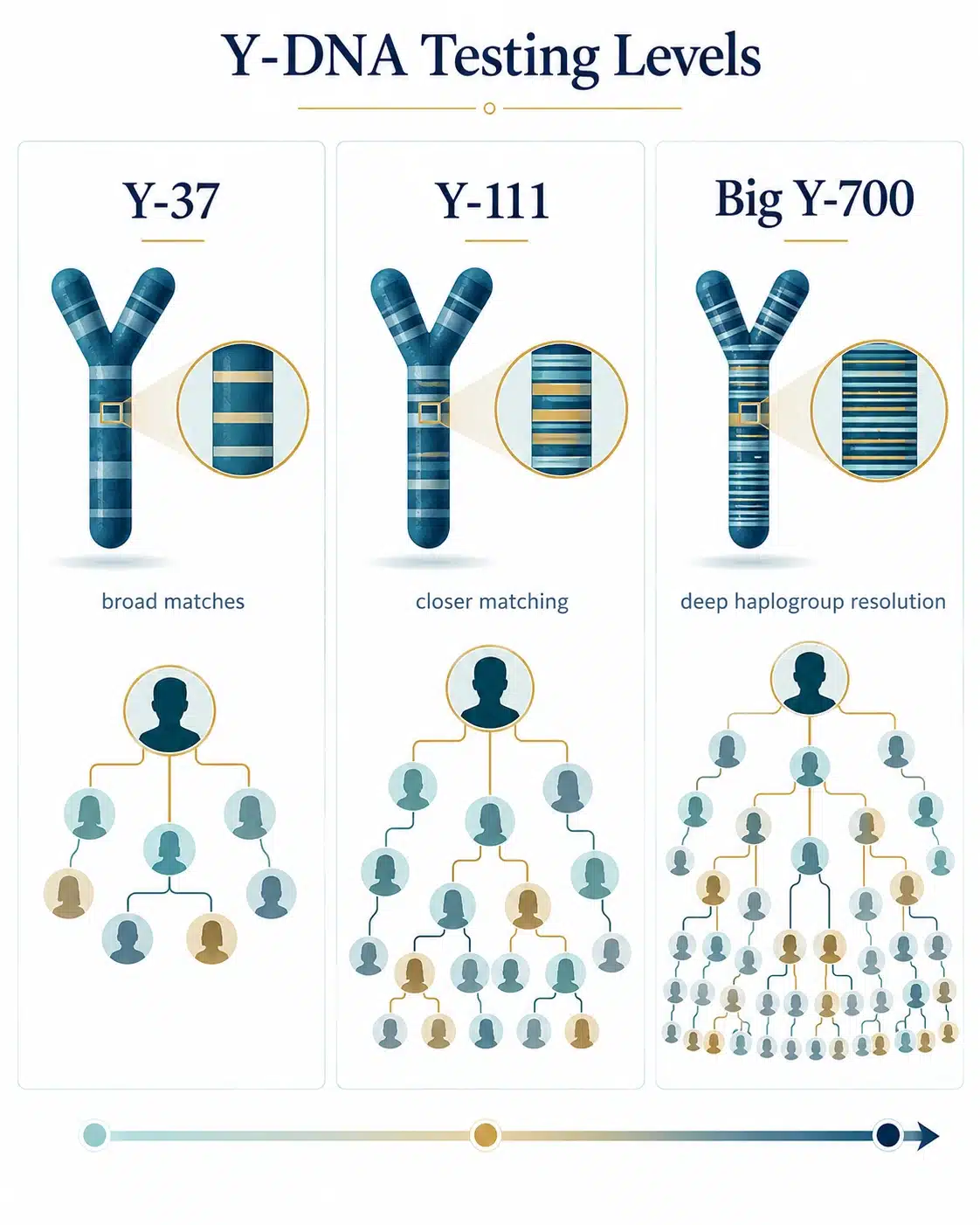
What is the difference between Y-37, Y-111 and Big Y-700?
| Option | Level | Practical purpose | Haplogroup outcome |
|---|---|---|---|
| Y-37 | 37 Y-STR markers | Start exploring direct paternal matches and broad surname-line connections | Predicted Y-haplogroup |
| Y-111 | 111 Y-STR markers | Compare paternal matches with greater STR detail and assess branch hypotheses | Predicted Y-haplogroup |
| Big Y-700 | Extensive Y-STR plus Y-SNP testing | Advanced paternal branch, sub-branch and genetic-tree research | Confirmed, more refined haplogroup assignment |
Should you begin with Y-37 or go directly to Big Y?
Choose Y-37 if you are testing a new paternal line and want to see whether potentially informative matches exist. Choose Y-111 when you have a more developed family-history question and want extra Y-STR resolution. Consider Big Y-700 when your goal is deeper haplogroup placement, distinguishing related paternal branches or participating in advanced lineage research. The most detailed test is not automatically the best value for every beginner.
A haplogroup describes a genetic branch on a paternal or maternal tree. Y-STR matching and Y-SNP branch placement can contribute different evidence; a shared broad haplogroup alone does not prove a close genealogical relationship.
Full mtDNA Sequence: Research Your Direct Maternal Ancestry
Unlike Y-DNA, mitochondrial DNA (mtDNA) is inherited by children of all sexes from their biological mother. However, daughters—not sons—normally pass this mitochondrial lineage to the next generation. That makes Full mtDNA Sequence testing useful for investigating one direct maternal line across many generations.
The Full mtDNA Sequence ancestry test analyzes the mitochondrial sequence to provide maternal haplogroup information and potential maternal-line matches where comparable testers are available.
What can a maternal haplogroup tell you?
It can identify a branch of the worldwide mitochondrial genetic tree and offer historical context for the distant maternal line. It cannot independently identify the names of your maternal ancestors, all the countries in your family history, or one particular recent maternal relative. Two people sharing a broad maternal haplogroup can have a very distant common maternal ancestor.
Useful research scenario: You have oral histories about a maternal ancestor who migrated between coastal Arabia and another Indian Ocean region. mtDNA may provide a maternal-line connection to investigate, while ship records, marriages, family documents and additional family matches help evaluate the history.
Which Ancestry DNA Test Should You Choose for Your Research Goal?
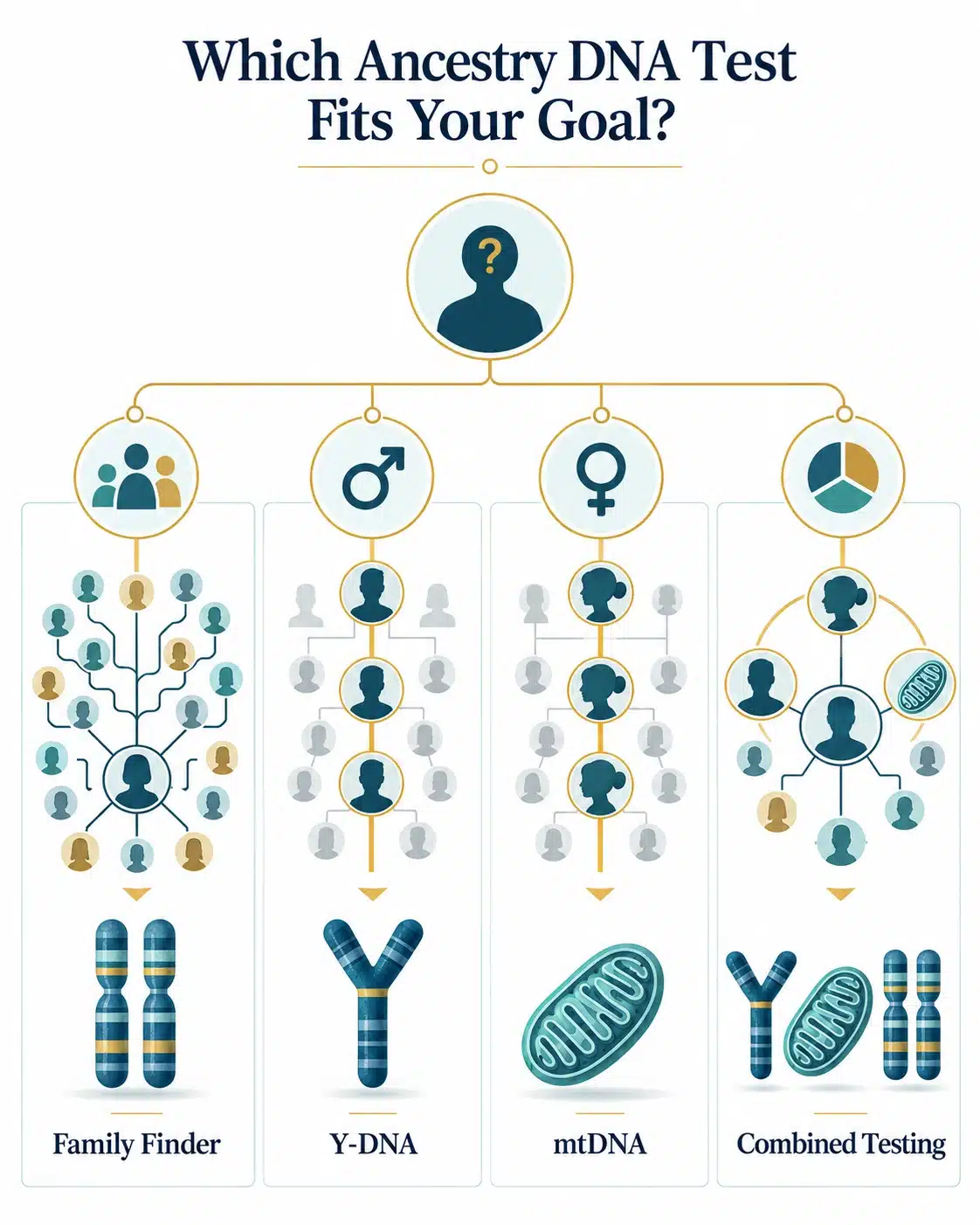
Instead of choosing by price alone, start with the information you want to obtain. These recommendations reflect each test's scientific purpose, not an assumption that more expensive testing always provides better answers.
“I simply want to know where my ancestors came from.”
Start with Family Finder. It supplies broad ancestry estimates and potential DNA matches. Then use documented genealogical evidence to interpret findings.
“I want to research my paternal ancestors or surname line.”
Explore Y-DNA 37 or 111. If you already have advanced matching goals or paternal branch hypotheses, Big Y-700 may offer greater research depth.
“I want to learn about my mother's direct maternal ancestors.”
Choose Full mtDNA Sequence. It focuses on maternal haplogroups and direct maternal-line genetic connections rather than all of the mother's ancestors.
“I want several kinds of ancestry evidence in one project.”
Choose an ancestry DNA package that includes Family Finder plus the paternal and/or maternal-line test appropriate to your question.
Can a DNA test prove your tribe or ancestral clan?
No single ancestry DNA test can establish or certify tribal identity. For families researching a traditional tribal genealogy, Y-DNA can supply evidence about the genetic relatedness of sampled paternal lines. But shared genetic ancestry does not, by itself, establish an exact tribe, genealogy, legal status, surname or historical pedigree. Conclusions require documentary evidence, representative comparative samples and careful interpretation. Claims that a particular haplogroup uniquely proves membership in a named tribe should be treated skeptically.
A stronger research approach compares tested paternal-line relatives, existing family records and documented relationships. Genetic evidence can support or challenge a lineage hypothesis; it cannot, on its own, replace historical research.
Family Lineage DNA Packages: When Combining Tests Adds More Value
For an individual with several family-history questions, a combined package can provide a more coherent research plan than relying on one type of DNA evidence. Suspire's Family Lineage DNA Packages offer selectable combinations of Family Finder, Full mtDNA Sequence, Y-37, Y-111 and Big Y-700.
The principal advantage is complementary information: autosomal matches can help identify living cousins, while Y-DNA and mtDNA focus on specific paternal or maternal branches. A package does not make a test inherently more accurate, and it does not guarantee that a useful genetic match exists in the database.
| Package combination | Recommended for | What it adds |
|---|---|---|
| Family Finder + Y-37 | First-time ancestry researchers interested in their father's line | Broader origins and cousin matches, plus entry-level paternal-line comparisons |
| Family Finder + Y-111 | Researchers with paternal family-branch questions | Autosomal connections plus more detailed Y-STR matching |
| Family Finder + Big Y-700 | Advanced paternal genealogy projects | Wider family relationships plus deep paternal SNP-based analysis |
| Family Finder + Full mtDNA | People researching broad ancestry and their direct maternal line | Genetic relatives and ethnicity estimates alongside maternal haplogroup research |
| Full mtDNA + Y-DNA | Projects focused on two distinct direct lineages | A direct maternal lineage and a direct paternal lineage, provided an appropriate Y-DNA tester is available |
| Family Finder + mtDNA + Y-DNA | Comprehensive research involving multiple inheritance patterns | Combines wider genetic genealogy with direct maternal and paternal lineage evidence |
Illustrative research journeys: choosing the right combination
Journey 1 — Exploring a family with roots in several regions. The researcher wants to understand broad ancestral connections and identify possible genetic cousins. Start with Family Finder. Add a lineage test only after a specific direct-line question emerges.
Journey 2 — Comparing two documented paternal branches. The goal is to compare male-line descendants of two documented branches. Y-111 may support more detailed matching; Big Y-700 is worth considering for a well-developed project exploring branch-defining SNPs. Family documents remain essential.
Journey 3 — Following both cousin matches and a maternal line. Family Finder can identify potential relatives from multiple branches, while Full mtDNA Sequence explores one direct maternal lineage. The combination answers different but complementary questions.
Journey 4 — Evaluating a long-standing family migration story. Autosomal matches may identify contemporary DNA relatives; targeted Y-DNA or mtDNA can explore a specific direct lineage. None of these tests alone verifies an oral migration story. Records and comparative samples determine whether the story is supported.
These are hypothetical examples for education, not customer testimonials or case results. Package selection and tester suitability should be confirmed before ordering. All listed prices exclude VAT, if applicable, and separately charged shipping fees that cover kit delivery, sample pickup and shipment to the US laboratory.
Build a DNA package around your actual research goal
Choose two or three complementary ancestry tests, or ask Suspire which combination best suits your family history. Check the live package selector for the applicable combination and checkout total.
What Do Ancestry DNA Results Look Like—and How Should You Read Them?
Ethnicity estimates vs DNA matches
Ethnicity estimates are statistical comparisons with reference populations. They may be updated as datasets and methods change. DNA matches, by contrast, identify individuals who share measured DNA segments or lineage markers with you. Each finding has a different evidentiary meaning: an ethnic percentage is not the same thing as a documented cousin relationship.
What are centimorgans, genetic distance and haplogroups?
- Centimorgans (cM): a unit used when estimating how much autosomal DNA two people share. Greater shared amounts often suggest closer relationships, but ranges can overlap.
- Y-STR genetic distance: a measure of differences between Y-STR marker profiles. Its interpretation depends on how many markers were tested and the historical context.
- Haplogroups: branches of a direct paternal or maternal genetic tree, typically identified using inherited variants. A broad shared haplogroup does not automatically indicate a recent common ancestor.
Can a DNA result identify the exact town or country of an ancestor?
Not by itself. Borders, migration histories and group labels differ from genetic population structure. A regional ancestry signal may be compatible with several nearby populations. Strengthen a hypothesis with a documented family tree, place-of-origin records, relevant genetic matches and—when appropriate—targeted lineage testing.
Family migrations rarely follow present-day national borders neatly. Genetic ancestry can inform a hypothesis about connections between populations; places, dates and named ancestors usually require documentary evidence.
How to Plan an Ancestry DNA Test That Answers Your Question
A useful genetic genealogy project begins before the sample is collected. Think about the missing piece of your family history: an unknown cousin connection, a disputed paternal branch, a maternal lineage or an account of migration passed down through generations. Your answer determines which DNA test—and which person to test—will provide the most relevant information.
What are you trying to discover?
Write down one specific question. Family Finder is useful for wider family connections; Y-DNA and mtDNA follow one direct paternal or maternal line. Combining tests is worthwhile when you genuinely need both kinds of evidence.
Whose DNA is most informative?
For general ancestry, test yourself. For a paternal line you do not carry, an appropriate consenting relative may be essential. In a complex family-tree investigation, the right participant can matter more than buying a more advanced test.
How will you use the results?
Compare DNA matches, haplogroups and reported ancestral locations with your family tree. Contact possible relatives respectfully, review the strength of each match and keep a record of what has—and has not—been established.
What happens after you choose your ancestry test?
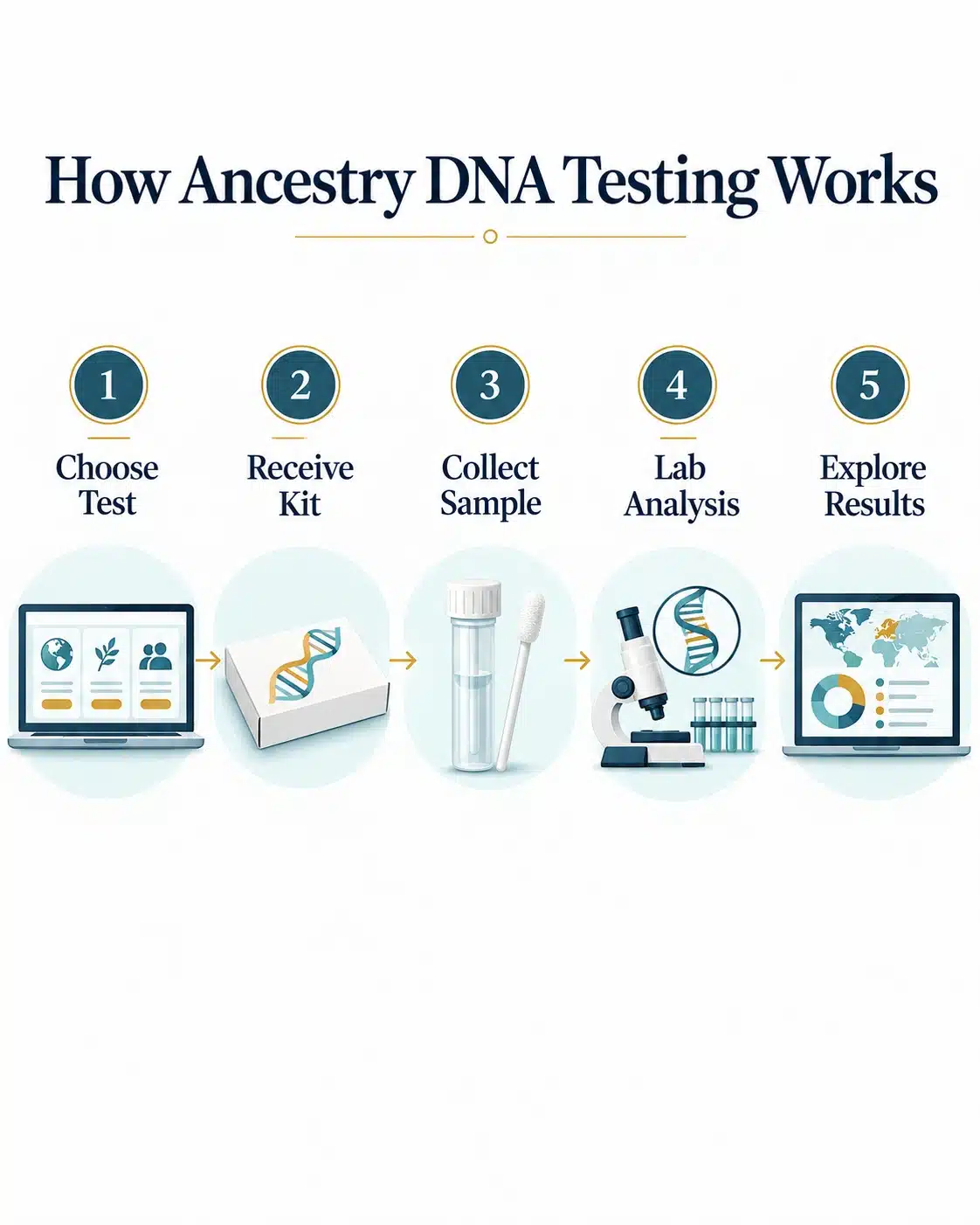
Who does what? Suspire coordinates the customer-facing process where available; you collect your own cheek-swab sample following the supplied instructions; FamilyTreeDNA carries out the laboratory testing and makes the results available through its account platform.
- Select the test or package. Match the test to your genealogy question and confirm who will provide each sample.
- Receive the collection kit. Suspire coordinates delivery of the test kit and explains the collection instructions. The separately charged shipping fee covers kit delivery, sample pickup and onward shipment to the US laboratory.
- Collect the cheek-swab sample. Follow the supplied instructions and obtain appropriate consent from every participant.
- Arrange sample pickup and laboratory dispatch. Following collection, Suspire coordinates pickup and onward shipping of the sample to the FamilyTreeDNA laboratory in the United States for analysis.
- Explore your results. Review ancestry estimates, genetic matches or lineage reports as relevant—and bring them together with documents, family interviews and your research notes.
Ancestry testing enquiries across the Gulf: Suspire assists customers in the UAE, Saudi Arabia, Bahrain, Qatar and Oman with choosing available FamilyTreeDNA tests and understanding the ordering process. The team can confirm kit delivery, sample pickup, onward shipment to the US laboratory and the applicable final charges for your location before purchase.
Ancestry DNA Test Prices and Package Options
The table shows individual ancestry test prices in AED and links to Suspire’s product pages. All prices shown exclude VAT, if applicable, and shipping fees. Shipping fees are charged separately and cover DNA kit delivery, sample pickup and onward shipment to the FamilyTreeDNA laboratory in the United States for analysis. Package prices depend on the selected combination. Check the final total before placing an order.
| Ancestry test | Test price in AED* | Product page |
|---|---|---|
| Family Finder | AED 1,550 | View Family Finder |
| Y-DNA 37 | AED 1,480 | View Y-37 |
| Y-DNA 111 | AED 2,100 | View Y-111 |
| Big Y-700 | AED 3,200 | View Big Y |
| Full mtDNA Sequence | AED 2,400 | View mtDNA |
| Selected two-/three-test packages | Varies by combination | Check package selector |
*Pricing and shipping: All listed test prices are in AED and exclude VAT, if applicable, and shipping fees. The separately charged shipping fee includes delivery of the DNA collection kit, pickup of the collected sample and shipment of the sample to the laboratory in the United States for analysis by FamilyTreeDNA. Package prices vary by the tests selected. Final payable amounts depend on the chosen tests, destination, applicable tax, shipping charges and any currency conversion.
Results: Analysis and result turnaround times vary depending on the test selected and laboratory processing requirements. No single reporting timeframe applies to every ancestry test or package; consult Suspire for the relevant test’s current estimated timeline.
Is a combined ancestry package better value?
It can be, when two or more complementary tests help answer your research questions. Compare the selected package total with the current prices of its individual tests and consider whether the added test offers information you will actually use. A single well-chosen test may be the better starting point for a beginner.
Results, Privacy and Important Limitations Before You Order
How long do ancestry results take?
Result timelines vary depending on the ancestry test selected. Family Finder, Y-DNA, Big Y-700 and Full mtDNA Sequence can have different analysis and reporting schedules. Shipping transit and laboratory workload may also affect the overall journey, and results from combined packages may be released separately. Suspire can help explain the current estimated turnaround for your selected test; any estimate is not a guaranteed reporting date.
Is ancestry DNA testing private?
Genetic information is sensitive. Before ordering, review Suspire's privacy policy and the testing provider's applicable privacy, consent and matching settings. FamilyTreeDNA says Family Finder matching participation can be controlled, but specific account and data-use settings should be checked directly. Consider the possibility of unexpected biological-relative matches, and do not submit another person's sample without appropriate consent.
Can ancestry tests be used for immigration, court cases or legal paternity?
No—these consumer ancestry kits are not a substitute for a legal chain-of-custody relationship test. If your purpose is a court proceeding, immigration case or a formal paternity finding, disclose that requirement before testing so the correct legally appropriate process can be discussed.
What can these tests not promise?
- A guaranteed match with a living relative in a database.
- Exact nationality, tribe, caste, surname or religious affiliation.
- Certainty about every ancestor in a family tree.
- Medical diagnosis or comprehensive health-risk screening.
- A fixed delivery or reporting date regardless of destination and test complexity.
These limits do not reduce the value of genetic genealogy. They help ensure DNA results are interpreted as evidence rather than identity certificates or historical proof by themselves.
Frequently Asked Questions About Ancestry DNA Testing
Does Suspire perform ancestry DNA testing in its own laboratory?
No. Suspire facilitates access to available FamilyTreeDNA ancestry tests by helping with test selection, kit delivery, sample pickup and shipment to the FamilyTreeDNA laboratory in the United States. FamilyTreeDNA performs the genetic analysis and provides the ancestry results. Suspire does not perform the laboratory analysis or issue the ancestry DNA report.
What is included in Suspire’s shipping fee for ancestry DNA testing?
Shipping fees are charged separately from the listed test prices and cover all three logistics stages: delivery of the DNA collection kit, pickup of your collected sample and onward shipment of the sample to the FamilyTreeDNA laboratory in the United States for analysis. The exact shipping charge is confirmed for your destination before ordering.
Are ancestry DNA prices inclusive of VAT or shipping?
No. The published test prices shown in this guide, including Family Finder at AED 1,550, exclude VAT if applicable and shipping fees. Shipping is charged separately and includes kit delivery, sample pickup and shipment to the US laboratory. Confirm the final amount payable before you order.
How long will I wait for my ancestry DNA results?
Result timing varies by the test. Family Finder, Y-DNA tests, Big Y-700 and Full mtDNA Sequence have different laboratory processing requirements. Suspire can share the current estimated timeframe for the selected test, but no single result date can be guaranteed for every test or package.
Which DNA test should I choose first for ancestry research?
For broad ancestry and DNA relatives, Family Finder is a useful first choice. Y-DNA is specialized for one direct paternal line, while Full mtDNA Sequence is for one direct maternal line. The right starting point depends on your research question.
Can I complete a FamilyTreeDNA ancestry test using a home collection kit?
Yes. Suspire helps arrange the FamilyTreeDNA test kit and provides guidance on the supplied collection instructions. The separately charged shipping fee includes kit delivery, sample pickup after collection and onward shipment to the FamilyTreeDNA laboratory in the United States for analysis. Confirm the complete charges and arrangements for your location before ordering.
Do ancestry DNA tests work for Arab and Middle Eastern ancestry?
They can provide genetic matching, reference-population comparisons and direct-line haplogroup information relevant to Middle Eastern ancestry. Results depend on the tested markers, quality of reference datasets and availability of participating matches; no test guarantees a precise Arab ethnic or tribal label.
Can DNA identify my Arab tribe?
No DNA test alone proves membership in a particular tribe. Y-DNA may help compare documented paternal lines, but a haplogroup or STR match is not an official tribal identification, and genetic conclusions must be combined with genealogy and other evidence.
Can a woman take Y-DNA test?
Y-DNA testing needs a sample carrying the relevant Y chromosome. A woman researching a direct paternal line may arrange an appropriate Y-chromosome-bearing relative to test with informed consent. Women can take Family Finder and Full mtDNA Sequence tests themselves.
Can men take a maternal ancestry test?
Yes. Men and women inherit mitochondrial DNA from their mother and can use Full mtDNA Sequence to research that direct maternal line. Sons normally do not pass mitochondrial DNA to their children.
What is the difference between Family Finder and Y-DNA?
Family Finder explores autosomal DNA inherited across many family branches and can provide estimated origins and DNA relatives. Y-DNA targets the direct father-to-son genetic line, making it useful for paternal matching, surname-line studies and haplogroup research.
Is Big Y-700 better than Y-111 for everyone?
No. Big Y-700 offers deeper SNP-based paternal-tree analysis, but a beginner seeking broad paternal matches may find Y-37 or Y-111 better aligned with the project. Choose Big Y for a specific advanced paternal research question.
How far back can Y-DNA and mtDNA trace ancestry?
Both can connect a direct genetic line to branches that originated far back in human history. This does not mean they identify named ancestors at every generation or trace every family branch. Recent genealogical findings depend on meaningful genetic matches and records.
Can I find relatives living in another country?
Possibly. Family Finder compares DNA with participating testers in its database, so a match may live in a different country. Finding a particular relative cannot be guaranteed and depends on available samples, DNA sharing and matching choices.
Should I get Family Finder and mtDNA together?
Consider the combination when you want both broader autosomal ancestry and direct maternal-line information. If you only want an initial regional ancestry estimate or general cousin matches, Family Finder alone may be enough at first.
Can an ancestry DNA test be used instead of a legal paternity test?
No. Family Finder, Y-DNA and mtDNA ancestry products are not intended to replace an identity-verified legal relationship test with the required chain-of-custody procedure.
When does it make sense to combine Family Finder with Y-DNA or mtDNA?
Combine tests when you have more than one research question. For example, Family Finder can identify autosomal relatives while Y-DNA investigates a direct paternal line; mtDNA provides distinct maternal-line information. Each test contributes a different part of the evidence.
Why might my ethnicity percentages change later?
Providers may update their population reference datasets and statistical methods. An updated result can change estimated regional percentages even when your underlying DNA does not change.
Can a package use more than one person's DNA?
Appropriate test participants depend on the research objective and the package's order configuration. For example, a woman may need an appropriate relative for a Y-DNA question. Confirm how tests and participants are assigned with Suspire before purchasing; do not assume every multi-test package automatically covers multiple people.
Start with the Question, Then Choose the DNA Evidence
Your ancestry is more than one percentage, one surname or one historical route. Family Finder offers a broad view of genetic origins and potential relatives. Y-DNA can investigate a direct paternal branch. Full mtDNA Sequence can illuminate one maternal line. Together, selected tests can add depth to a carefully researched family tree.
Suspire can help translate your research question into the right FamilyTreeDNA test or combination, explain the full kit-delivery and sample-shipping process, and confirm the applicable test price, any VAT, shipping fees and expected result timeline before you order.
Not sure where to begin with your ancestry research?
Tell us whether you want ethnic origin estimates, DNA relatives, a paternal or maternal haplogroup, or a multi-generation family-history project. We can help you select the most relevant test or package.
Scientific Sources & Further Reading
Test features are based on Suspire's published product information and FamilyTreeDNA documentation. The scientific cautions about genetic ancestry and identity reflect guidance from the U.S. National Human Genome Research Institute (NHGRI). Sources are supplied to help readers verify key distinctions.
- FamilyTreeDNA — Family Finder autosomal DNA test and matching.
- FamilyTreeDNA — Comparison of Y-37, Y-111 and Big Y-700.
- FamilyTreeDNA — Full mitochondrial DNA sequence testing.
- NHGRI — Genetic ancestry, ethnicity and population descriptors.
- NHGRI — Direct-to-consumer genetic testing limitations and privacy.
Editorial scope: This guide explains consumer genetic-genealogy testing. It is not medical advice, legal advice or certification of ancestry, nationality or tribal identity. All stated test prices exclude VAT, if applicable, and separately charged shipping fees covering kit delivery, sample pickup and forwarding to the US laboratory; confirm final charges and estimated result timings before ordering.
